Oddly Enough: The Art of Everyday Absurdity
There’s a moment early in my conversation with Vaughan Tomlinson where I completely lose my train of thought.
Not metaphorically. Fully gone. Restart the intro, laugh it off, keep going. It stays in the final cut because it felt right for the kind of conversation we were about to have.
That’s more or less the energy behind Oddly Enough. It’s sharp, a little offbeat, and built on the kind of observations you almost miss if you’re not paying attention.
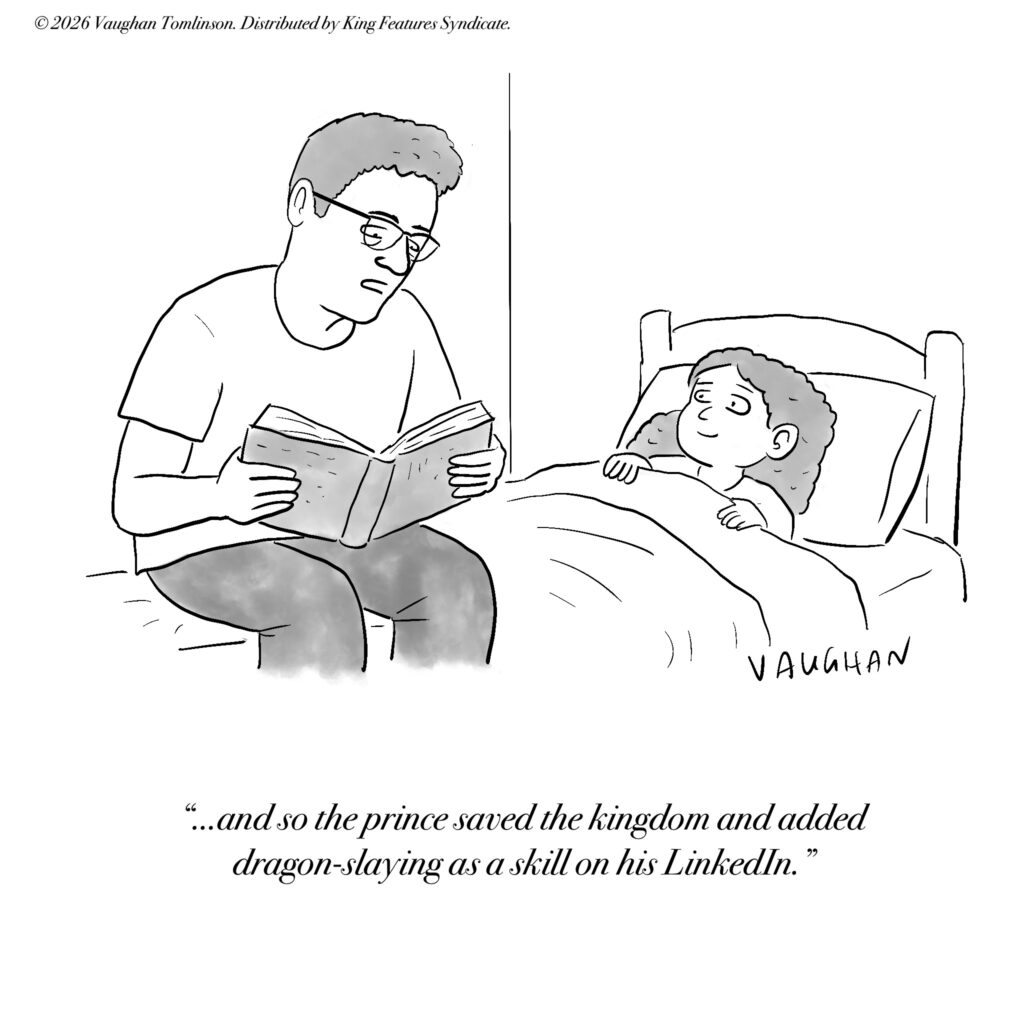
Vaughan didn’t come up through the usual path of daily comic strips. His background is rooted in single-panel cartoons, the kind you’d find in The New Yorker, where every idea has to stand on its own. No safety net, no extra panels to explain the joke. It either lands or it doesn’t.
That discipline shows up immediately in his work. Each panel feels simple at first glance, but there’s a lot happening underneath. The setup is quiet. The turn comes late. Sometimes it doesn’t even feel like a punchline so much as a shift in perspective.
We talked about how that kind of thinking develops. Not in a studio, not at a desk, but walking around, overhearing things, noticing small moments that most people filter out. A guy selling umbrellas in the middle of a downpour. Someone dressed for winter on a day that suddenly feels like June. Those details don’t just stay observations. They turn into something else entirely.
That’s really the core of Oddly Enough. It’s not trying to be loud. It’s not chasing a specific topic or audience. It’s just paying attention.
Vaughan’s path into cartooning wasn’t immediate either. He grew up loving comics, but didn’t see it as a realistic career until much later. It started as something occasional, then something more serious during the pandemic, and eventually something consistent. Submitting batches of cartoons each week, tracking what lands where, building a rhythm that feels equal parts structured and chaotic.
And then there’s the part that doesn’t show up on the page. The ideas that get lost. The notes that don’t make sense the next morning. The jokes that almost worked but didn’t quite get there. It’s a reminder that what looks effortless usually isn’t.
One of the more interesting parts of hosting this show is seeing how different cartoonists respond to an audience. With Oddly Enough, there’s this quiet feedback loop. Readers comment, reinterpret, sometimes even extend the joke in ways Vaughan didn’t expect. That back-and-forth becomes part of the process, whether directly or indirectly.
It’s also what makes reading the strip feel a little different here. You’re not just looking at a finished piece. You’re seeing something that continues to evolve.
If you’ve spent any time with Oddly Enough, you already know the tone. If you haven’t, it’s the kind of strip that doesn’t ask much from you. Just a moment of attention.

You can find Vaughan’s work on Comics Kingdom, learn more about him here, or see what he’s working on in real time over on Instagram.
The rest of the conversation fills in the gaps. Not everything, but enough to make you look twice at the next panel.
Please check your cookie settings to display this video.