80 Years in the Wild: Celebrating Mark Trail
For eight decades, Mark Trail has invited readers to step outside — into forests and wetlands, across mountain ridges and riverbanks — and see the natural world not as backdrop, but as something alive, fragile, and worth fighting for.
It launched on April 15, 1946, in the New York Post, distributed to 45 newspapers. It would eventually reach nearly 500. The strip has outlasted most of what surrounded it on those pages, not by chasing trends, but by committing — from day one — to a mission that has only grown more urgent with time.
We’re proud to mark this 80th anniversary. And we thought the best way to do that was to go back to the beginning — literally — and walk through what this strip has been, era by era, and why it still matters today.
Day One: A Dog, a Soldier, a Strip
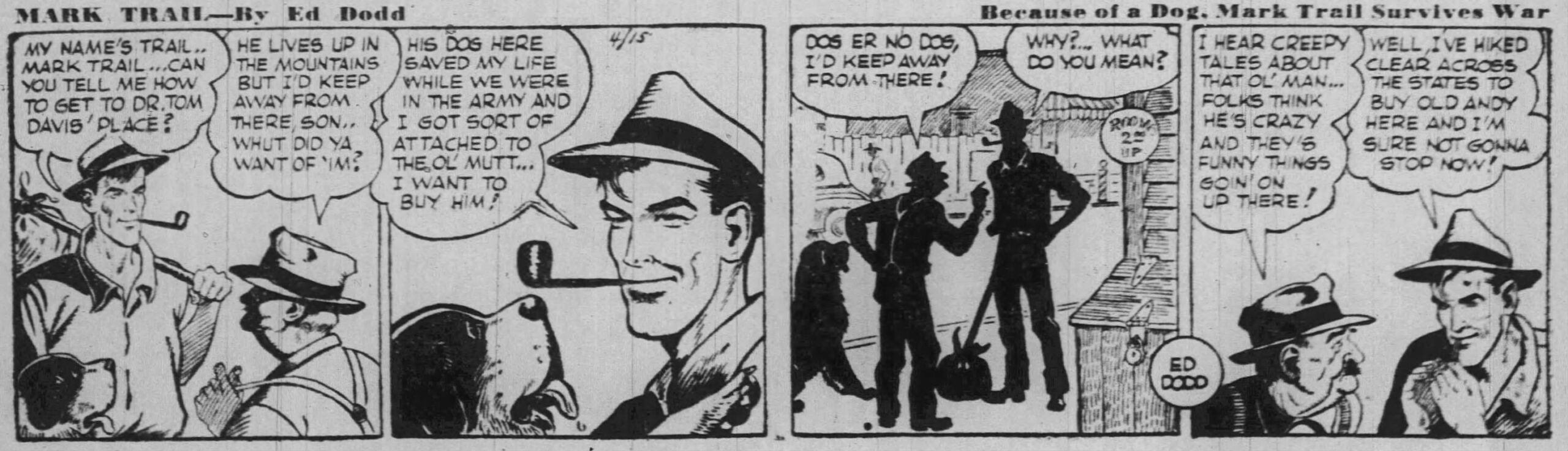
This is the real thing: April 15, 1946, as it appeared in the St. Louis Globe-Democrat. The headline above the panels reads, Because of a Dog, Mark Trail Survives War.
In six panels, Mark introduces himself, asks directions to Dr. Tom Davis’s place, and explains his mission: he wants to buy a St. Bernard named “Dos” — the dog who saved his life while he was serving overseas. A stranger warns him to stay away from the old man’s property. Funny things going on up there. Mark Trail has hiked clear across the country for this dog, and he isn’t stopping now.
In roughly 60 words of dialogue, Ed Dodd established everything the strip would become: a returning soldier with a moral compass, a mystery worth investigating, a wilderness setting, and an animal at the center of it all. The bones of Mark Trail were all there in the first panel.
What’s easy to overlook is how grounded Dodd kept it. The character of Mark Trail was loosely based on Charles N. Elliott, a real U.S. forest ranger who later edited Outdoor Life magazine. The physical model Dodd cited was John Wayt, his former neighbor in north Atlanta. Even the setting — Lost Forest — was modeled on a real place: a 130-acre wooded property outside Atlanta where Dodd kept his studio, his animals, his fishing lake, and yes, a Saint Bernard named Andy.
The strip wasn’t borrowed from adventure serials. It was borrowed from Dodd’s own life.
Ed Dodd: Conservation Before It Was a Cause
Ed Dodd (1902–1991) didn’t arrive at conservation as a message. He arrived at it as a way of life. Born in LaFayette, Georgia, he spent his youth outdoors, worked thirteen summers at a boys’ camp run by Dan Beard — a founder of the Boy Scouts of America — and became a scoutmaster and physical education director in Gainesville before studying architecture, dropping out, buying a Wyoming ranch, and working as a national parks guide before landing in advertising in the mid-1940s.
By the time he sold Mark Trail to a syndicate, he had decades of lived experience to draw from. The details in the strip were never decorative. The way animals moved, the legal texture of a poaching investigation, the specific ecology of a watershed — all of it grounded in things Dodd actually knew.
The strip earned more than 30 conservation awards from organizations including the National Wildlife Federation and the U.S. Fish and Wildlife Service. In 1967, Dodd was named Georgia Conservationist of the Year. And in 1991 — the same year he died — Congress designated 16,400 acres of forest along the Appalachian Trail in Georgia as the Mark Trail Wilderness. It remains the only comic strip character ever honored in that way.
The strip he built outlasted him. That was always the point.
A Different Kind of Hero
Mark Trail doesn’t wear a cape. He carries a camera. As a photojournalist and outdoor magazine writer for Woods and Wildlife, his assignments lead him into danger not through fantasy, but through consequence — the kind that follows from exposing illegal hunting, environmental damage, or the slow erosion of wild places.
The stakes in Mark Trail have always been real ones: ecosystems disrupted, species endangered, landscapes changed forever. What made — and still makes — Mark enduring is that he doesn’t just observe. He acts. He educates. He invites readers to care. The strip never treated conservation as a backdrop; it was always the story.
Four Artists. One Strip. Eighty Years.
Mark Trail has been shaped by four principal creative voices. Each one left the strip different than they found it. Each one kept the mission.
Ed Dodd Era (1946–1978)
Dodd founded the strip and set its terms: naturalistic art, an earnest conservationist protagonist, and stories grounded in real environmental science. Artist and naturalist Tom Hill joined him in 1946 to draw the Sunday pages — devoted entirely to wildlife education — until 1978. Even Jack Davis, later a Mad magazine institution, spent a summer in the late 1940s inking the daily strips.
Dodd also hired Jack Elrod in 1950, a former Boy Scout who had grown up around the strip and would go on to become its longest-serving steward.
Jack Elrod Era (1978–2014)
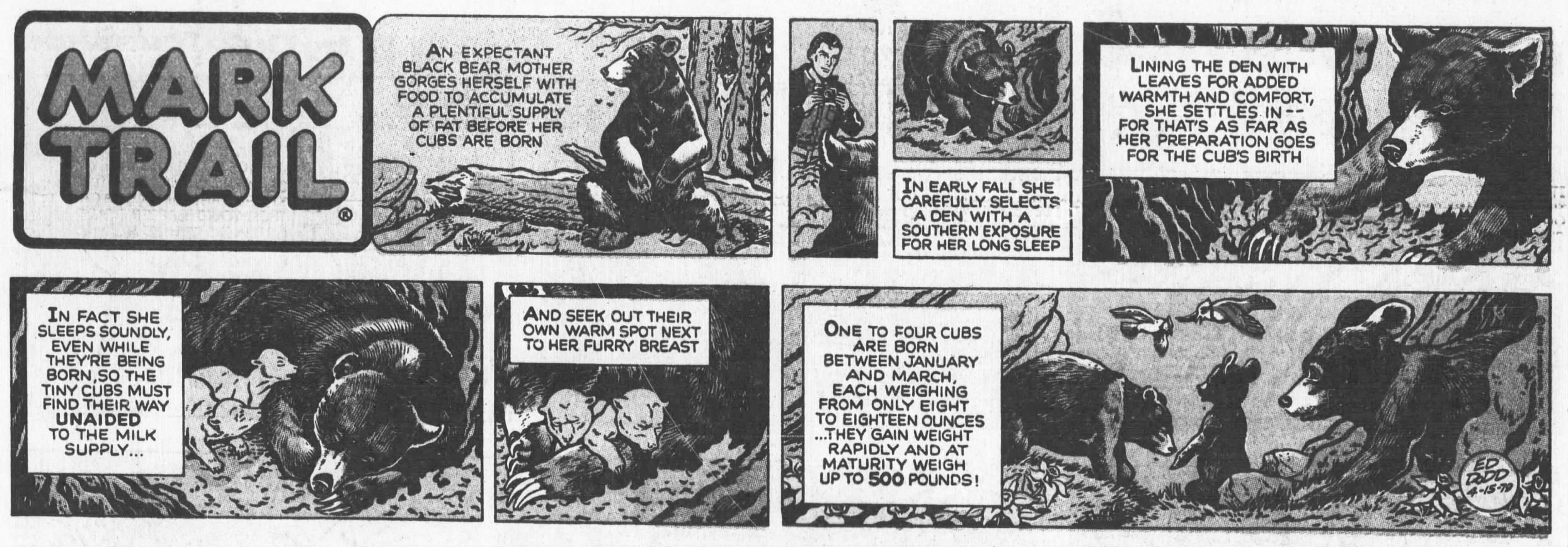
Elrod had been part of the Mark Trail studio since 1950, starting as a background artist and letterer. When Dodd retired, Elrod took full creative ownership and held it for over three decades. His Sunday pages — like the 1979 Atlanta Constitution strip above — were dense, immersive nature lessons: meticulous animal anatomy, behavioral science, ecological fact rendered in a style that prized accuracy above all.
James Allen Era (2014–2020)
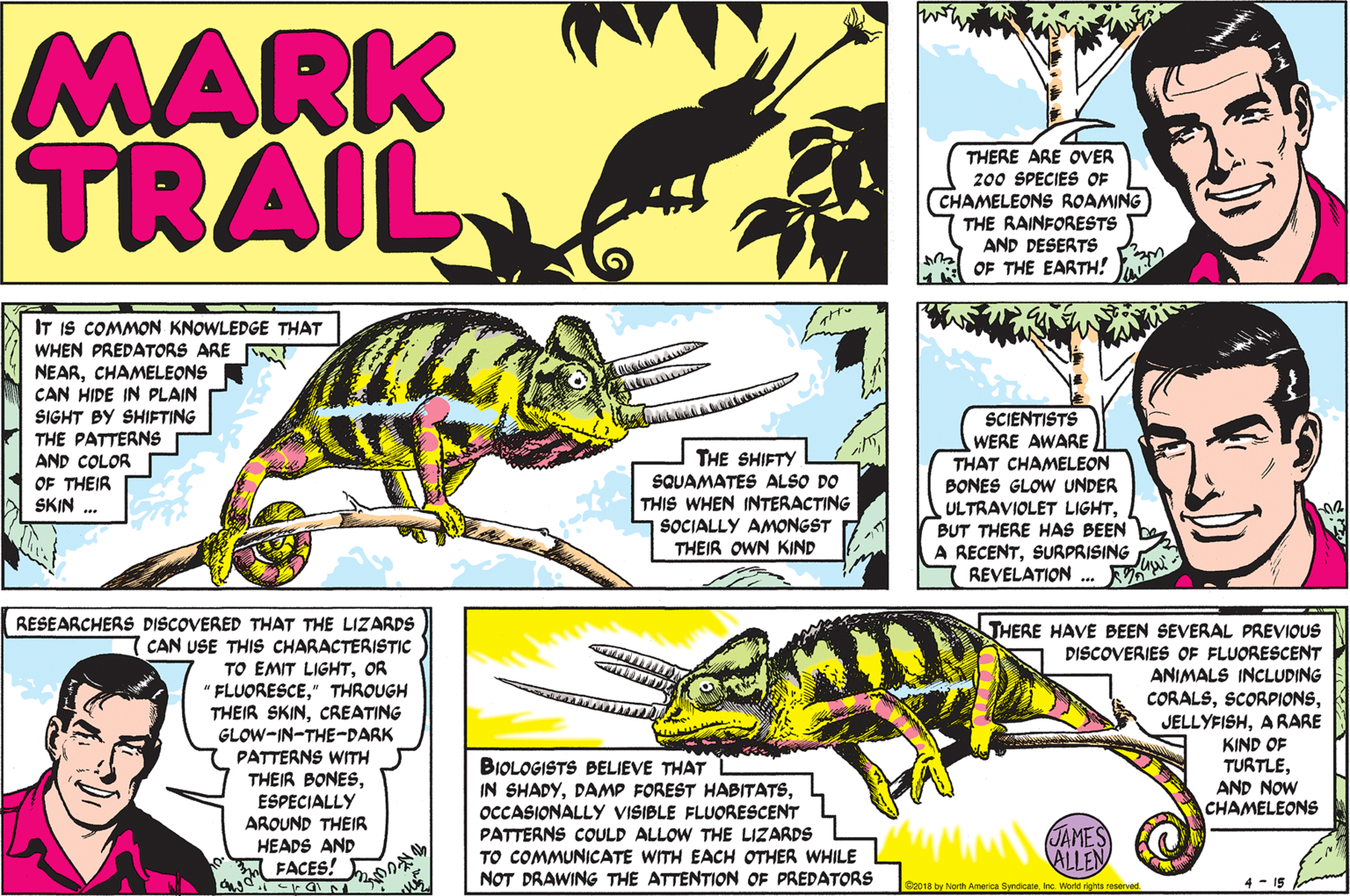
Allen was trained by Elrod, brought on as an assistant around 2004, and formally took over in 2014. His version of the strip maintained the naturalistic visual tradition — lush color Sunday pages, carefully rendered wildlife, conservation storylines that carried real ecological stakes. The 2018 Sunday page above, covering chameleon fluorescence and communication, is a clean example: scientifically current, visually polished, true to the educational model Elrod had established. Allen’s run ended in mid-2020.
Jules Rivera Era (2020–Present)
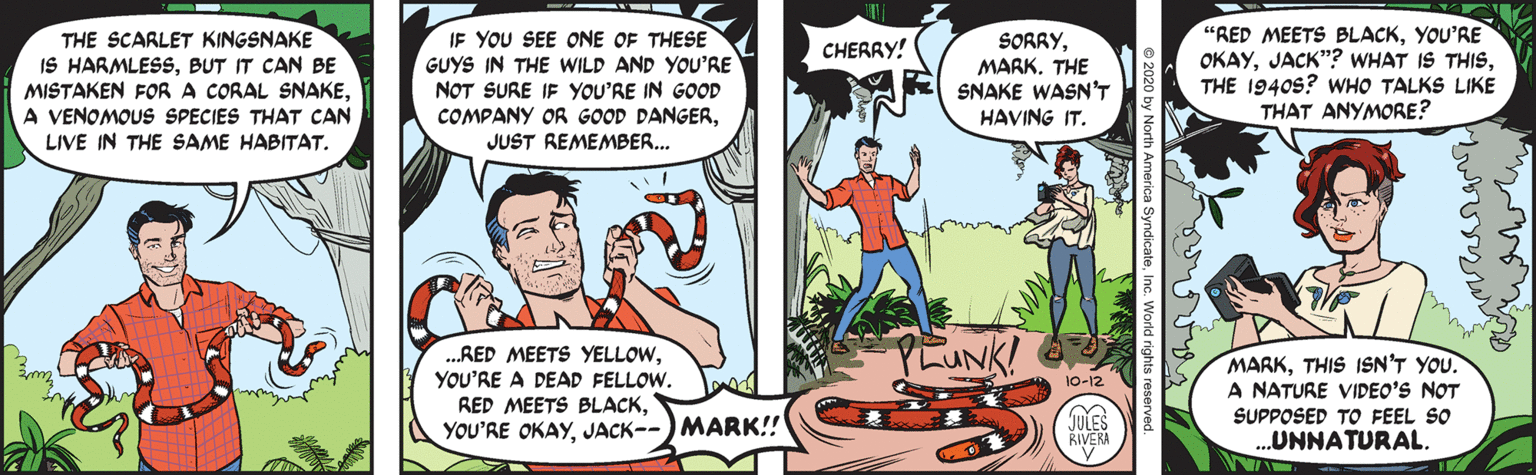
Rivera took over on October 12, 2020, and made her intentions clear from the first daily strip. The art shifted — from photorealistic to expressive and stylized. The pacing got sharper. The humor surfaced. Characters, particularly Cherry Trail, developed a wit and interiority that gave the strip new energy. Rivera, a former electrical engineer and creator of the webcomic Love, Joolz, became the first daily syndicated female Latinx cartoonist — bringing both a new voice and a genuine commitment to the strip’s environmental roots.
Her debut strip is above, and it’s worth reading closely. Mark is mid-monologue about the Scarlet Kingsnake. The snake, unimpressed, exits. Cherry, directly addressing the reader, asks the question Rivera’s version of the strip would spend years answering: what does it look like when Mark Trail feels like itself again? Her take is more self-aware, more contemporary in tone — but the science is still there, the wilderness is still the point, and the mission Ed Dodd set in 1946 is still running.
Why It Still Matters
Eighty years ago, Mark Trail was ahead of its time. Today, it feels like it was always pointing at this moment.
Climate change, habitat loss, and the tension between development and preservation are no longer slow-moving background concerns. They show up in weather, in policy, in daily life. In that context, a strip that has spent 80 years making those tensions personal and legible — first in 45 newspapers, now across digital platforms worldwide — is more than a legacy property. It’s a record of how long these questions have mattered, and proof that comics have always been a serious place to ask them.
At its best, Mark Trail doesn’t lecture. It shows. A single panel can hold the entire tension between a wilderness and the people who threaten it. A story arc can trace the ripple effects of one decision across an ecosystem. The strip earned its place not just by being consistent — strip after strip, decade after decade — but by being right about what it was pointing at.
Looking Ahead
We’re continuing to celebrate this milestone throughout the month — with archival strips, creator spotlights, and a closer look at the stories and panels that have defined Mark Trail across all four eras. Follow along on Comics Kingdom, and if you haven’t read the strip lately, there’s no better time to start.
Eighty years in, Mark Trail is still out there. Still paying attention. Still finding things worth fighting for.
That’s a legacy worth celebrating — and a story that isn’t finished yet.