Celebrating 107 Years of Barney Google and Snuffy Smith
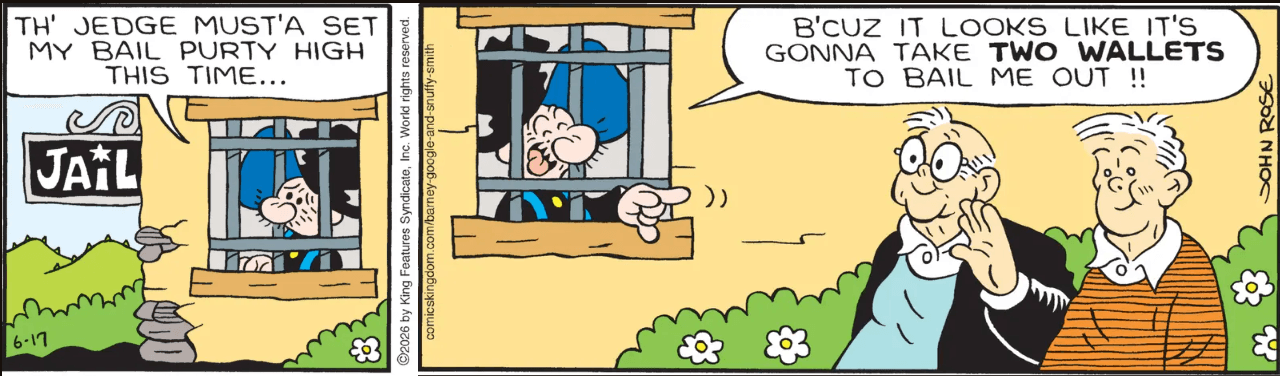
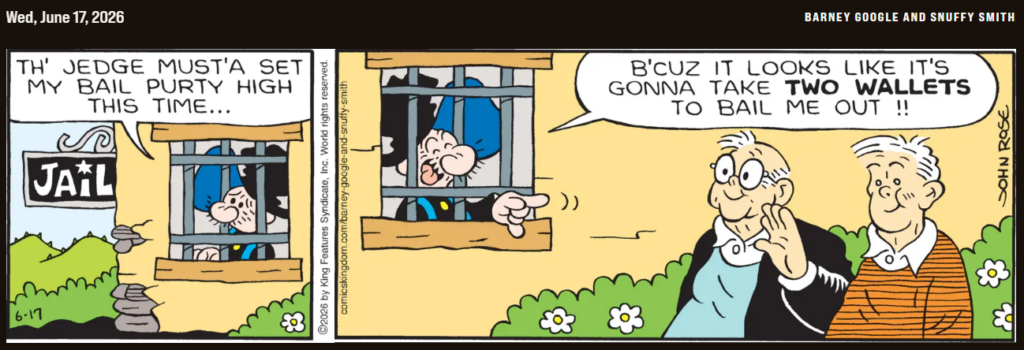
On June 17, 1919, readers met a wiry, bug-eyed character named Barney Google for the first time. More than a century later, Barney Google and Snuffy Smith remains one of the great survivors of the funny pages: a strip that has reinvented itself again and again while keeping its comic spirit unmistakably intact.
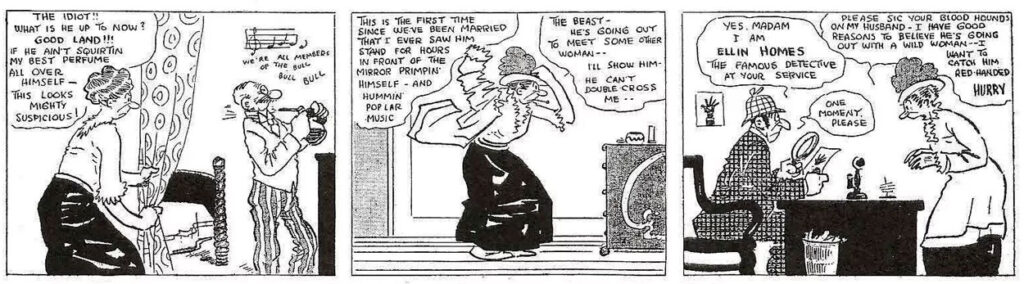
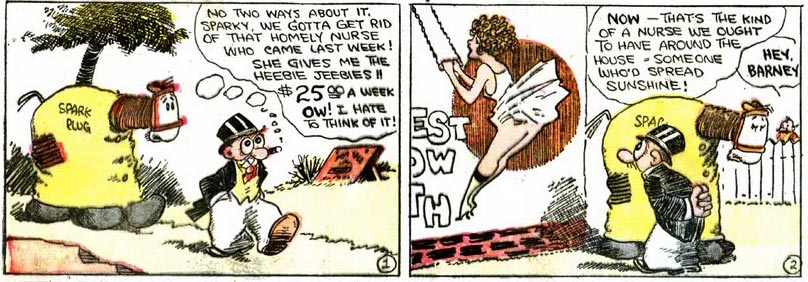
Created by Billy DeBeck, the strip began as Take Barney Google, For Instance, a gag-a-day feature about a small, scheming sports fan with a talent for trouble and a weakness for betting. Barney was not exactly a model citizen, which may explain why readers liked him. He was crafty, unlucky, vain, resilient and, above all, funny. In other words, he was built for the comics page.
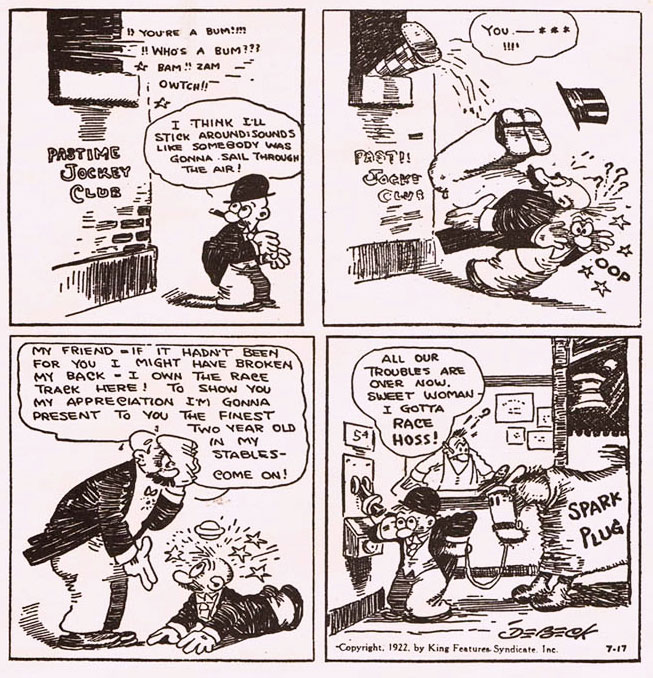
The strip’s first major transformation came in 1922 with the arrival of Spark Plug, Barney’s beloved racehorse. Sparky quickly became more than a supporting character. With his blanket-covered body, stubborn personality and underdog charm, he helped turn the strip into a national sensation. Barney and Spark Plug’s racing adventures expanded the world of the comic, sending them far beyond the original setup and into serialized escapades that kept readers coming back day after day.
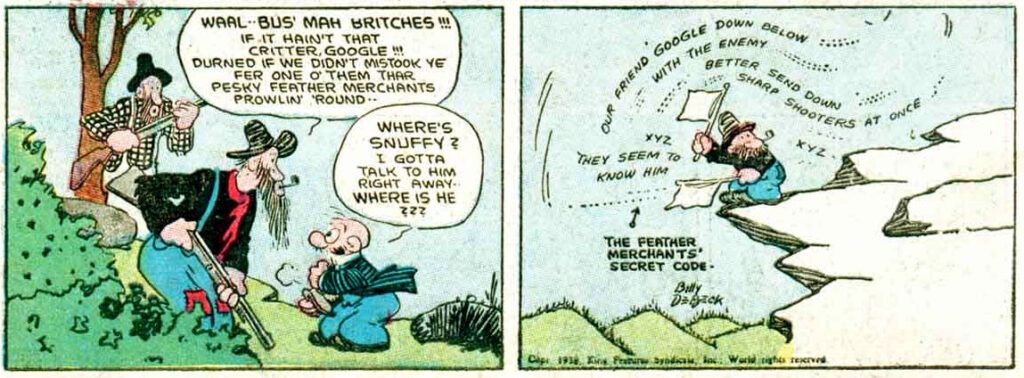
Then came another turning point. In 1934, Barney traveled into the mountains and met his distant cousin, Snuffy Smith. What might have seemed like a temporary detour became the foundation for the strip’s next era. Snuffy, with his oversized hat, short fuse and bottomless appetite for mischief, gradually took center stage. Hootin’ Holler became the strip’s home, and the comic’s humor shifted toward the daily rhythms, rivalries and absurdities of its mountain community.
That sense of place is part of why the strip has lasted. As John R. Rose notes in his Inside the Kingdom conversation, Hootin’ Holler is more than a stand-in for Appalachia. Over time, it has become its own fictional mountain community, with its own rhythms, rivalries, families, jokes and familiar faces. Readers do not only return for Snuffy’s next scheme. They return because the place feels lived in.
Rose knows that world as both a cartoonist and a steward. He joined the strip in 1998 as Fred Lasswell’s inking assistant and became the cartoonist of Barney Google and Snuffy Smith in 2001 after Lasswell’s passing. Nearly 25 years later, he still speaks about the role with real gratitude, describing it in the interview as “the greatest joy of my professional career.”
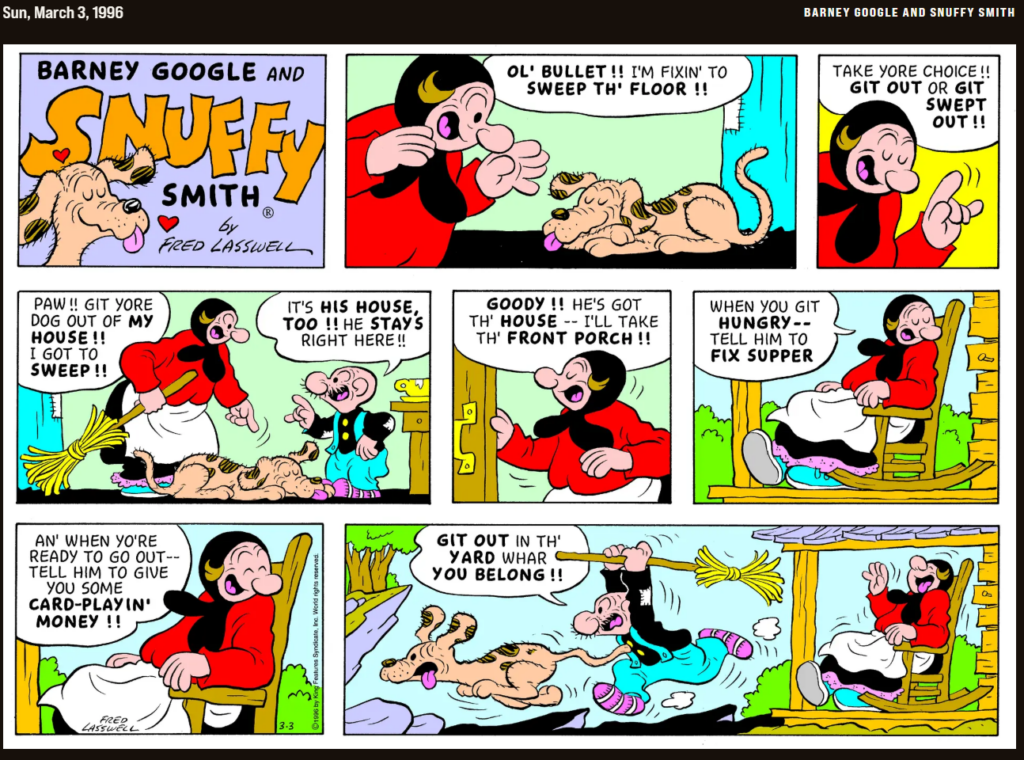
His path to the strip has the kind of charming, unlikely detail comics history tends to reward. After sending samples to Lasswell in hopes of finding a place on the strip, Rose received a call two weeks later while eating Cocoa Puffs. Lasswell’s first bit of feedback was wonderfully specific: “I really like the way you draw big noses.” That call helped lead to Rose’s hiring, and to a creative relationship that connected him directly to the strip’s long lineage.
Rose’s story also speaks to the quieter forces that keep cartooning alive: teachers, mentors and readers who notice a young artist and encourage them forward. In the interview, he recalls writing and illustrating a book in fifth grade, then seeing his teacher and principal help publish it and hold a school book signing. The project raised enough money for Boy Scout camp, but its bigger gift was the belief that drawing could become a real path. Later, while attending James Madison University, encouragement from editorial cartoonist Mike Peters became another turning point.
That kind of generational connection runs through the strip’s audience, too. Parents and grandparents introduce Barney, Snuffy and the people of Hootin’ Holler to younger readers. At conventions, Rose still meets fans discovering the strip for the first time, including young readers who bring their own affection to the characters. One especially sweet example from the interview: a fourth-grade student who created a Snuffy Smith pumpkin display for a school contest. Comics endure in the archive, yes, but they really live in moments like that.
The daily work behind those moments is still deeply hands-on. Rose keeps notebooks and sketchbooks filled with evergreen gag ideas. He sketches by hand, inks on Bristol board and uses digital lettering with a custom font. A daily strip may take a few hours. A Sunday strip takes significantly more time. The process is traditional, practical and personal, which feels right for a comic with such a long memory.
That kind of evolution is rare. Many long-running strips become famous for staying the same. Barney Google and Snuffy Smith became famous for changing without losing itself. Across its lifetime, the strip has moved from domestic comedy to sports satire, from horse-racing adventures to backwoods farce, from Barney’s schemes to Snuffy’s world. Through every reinvention, it has held onto the energy that made DeBeck’s work so popular in the first place: bold characters, elastic language, physical comedy and a deep love of ridiculous human behavior.
The strip’s influence reaches well beyond the comics page. Over the decades, Barney Google and Snuffy Smith inspired songs, films, animated cartoons, toys and comic books. Its language also left a mark on American slang, helping popularize colorful expressions that readers still recognize today, even when they no longer know where those phrases came from.
And then there is the legacy of Billy DeBeck himself. His success with Barney Google made him one of the defining newspaper cartoonists of the 1920s and 1930s. His work helped shape the rhythm of serialized comic storytelling, the power of breakout characters and the idea that a strip could grow into a sprawling comic universe over time.
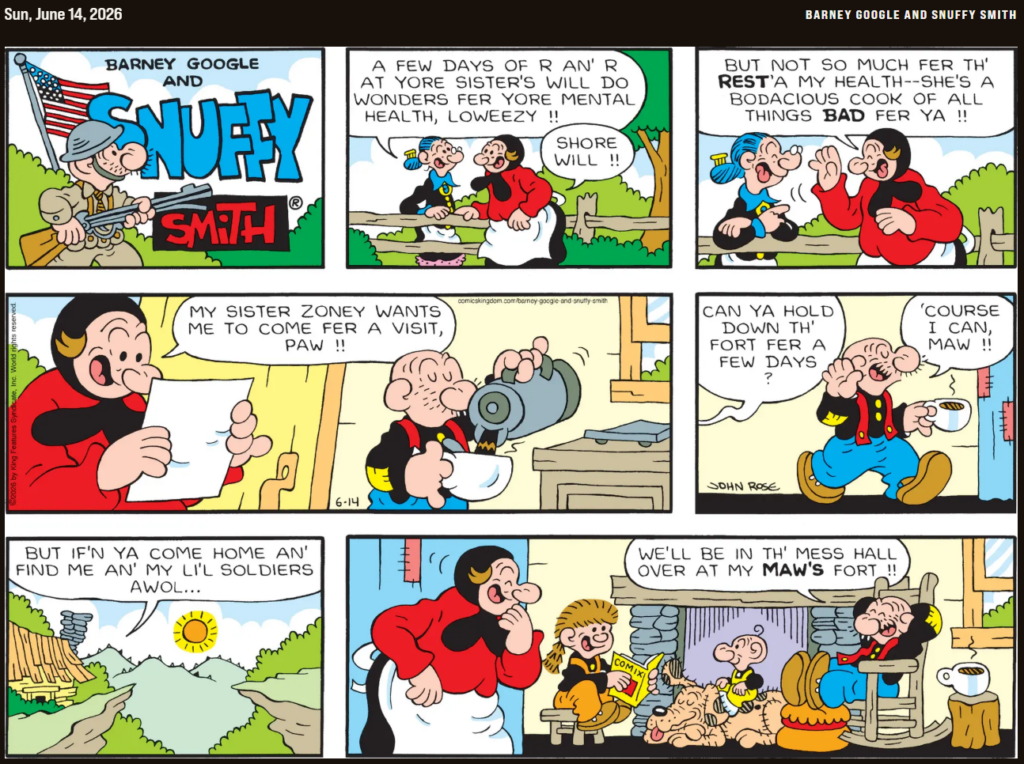
The story is still moving. Barney and Spark Plug continue to make recurring appearances, keeping the strip’s earliest era connected to its present. Rose has also teased more Barney Google material ahead, along with a new print collection, Up to Stuff. For a comic that began in 1919, that forward motion matters. It reminds us that legacy is not only what survives. It is what keeps inviting people back.
Today, 107 years after Barney Google first appeared, Barney Google and Snuffy Smith remains a living piece of comics history. It is a reminder that great cartoon characters do not simply stay frozen in the moment they were created. They wander, stumble, adapt, argue, scheme, survive and somehow keep making readers laugh.
Time’s a-wasting, as the old funny-page spirit might say. There are still more visits to Hootin’ Holler ahead.
Editorial source notes
Historical details are drawn from the Lambiek Comiclopedia profile of Billy DeBeck, including the 1919 launch of Barney Google, Spark Plug’s 1922 arrival and Snuffy Smith’s 1934 debut.
John R. Rose interview details are drawn from the Inside the Kingdom episode context provided for Barney Google & Snuffy Smith with John R. Rose.